
Health Star Rating and cooking oils: why edible oils need a targeted exemption pending review
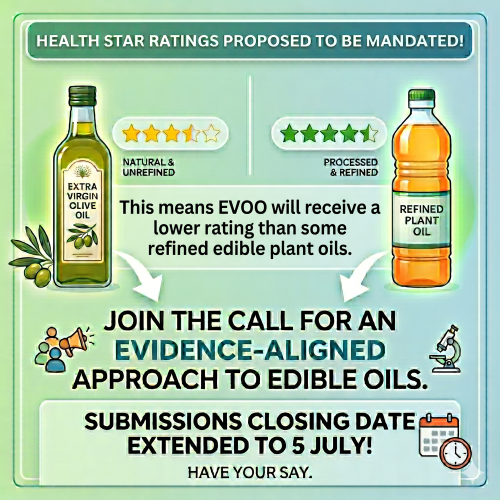
The Australian olive industry supports clear, consistent front-of-pack labelling that helps consumers make healthier food choices.
However, the current Health Star Rating algorithm is not fit for purpose for edible oils. In this category, the algorithm gives disproportionate weight to saturated fat, while not adequately accounting for degree of processing, refining, bioactive compounds, oxidative stability or the broader evidence base for extra virgin olive oil (EVOO) and EVOO-rich dietary patterns.1
As mandatory HSR is being considered, edible oils and cooking fats should be exempt from mandatory display requirements until the algorithm is reviewed and updated to better reflect the evidence.
This is a targeted request for category-specific correction. It is not a request to delay mandatory HSR implementation across all packaged foods.
Key problems with the current HSR system
- The algorithm is not appropriate for edible oils
Edible oils are mostly single-ingredient culinary products. They are naturally energy dense and contain negligible sugar and sodium. As a result, saturated fat becomes the dominant factor determining the star rating. The current algorithm does not adequately account for degree of processing, refining, oxidative stability, or the retention of bioactive compounds.
This can lead to EVOO receiving a lower HSR than some more heavily refined plant oils, despite the broader evidence base supporting EVOO and EVOO-rich dietary patterns.
- The current system risks misleading consumers
Consumers may reasonably interpret the current ratings as suggesting that some refined oils are healthier choices than EVOO.
If mandatory HSR labels are accompanied by a government-funded consumer awareness campaign, this risks amplifying confusion in the oils category, particularly where ratings conflict with established dietary guidance, nutrition science and consumer understanding of healthy dietary patterns.
This does not strengthen trust in front-of-pack labelling. It risks eroding it.
- The current approach to edible oils is inconsistent with nutrition science
Extra virgin olive oil is not simply a source of fat. It is a minimally processed food that retains biophenols and other bioactive compounds, many of which are reduced or removed during refining.
A substantial body of high-quality evidence supports EVOO and EVOO-rich Mediterranean dietary patterns as cardioprotective,2, 3 neuroprotective,4, 5 and anti-inflammatory.6, 7 These types of health benefits are not seen to the same degree in other edible oils.5, 8, 9
The current HSR algorithm does not reflect this broader evidence. Instead, it reduces the oils category largely to a saturated-fat calculation.
- Category-specific adjustment is possible
The HSR system has previously been modified where the algorithm produced outcomes that were not aligned with dietary guidance or nutrition science.
For example, changes were made for dairy products after recognition that focusing too narrowly on saturated fat could produce misleading outcomes for foods such as cheese, milk and yoghurt.
The same issue now exists for edible oils. A category-specific solution is both possible and necessary.
Recommendation
The Australian olive industry recommends that edible oils and cooking fats be exempt from mandatory HSR display requirements until an independent, evidence-based review of the category is completed.
We support the goal of improving front-of-pack labelling and helping consumers identify healthier packaged foods. However, the current HSR algorithm was not designed for and therefore does not work appropriately for edible oils.
Mandatory implementation should proceed for categories where the algorithm is fit for purpose. But edible oils should be treated as a known category anomaly and exempted until the system can assess them in a way that reflects contemporary nutrition science.
An independent review of edible oils and cooking fats should consider:
- current scientific literature
- degree of processing and refining
- presence and retention of naturally occurring bioactive compounds
- food matrix effects
- oxidative stability and culinary application
- evidence from dietary pattern research, particularly Mediterranean dietary patterns
- the limitations of relying predominantly on saturated fat as the primary differentiating variable
The solution is not to hold up the whole Health Star Rating system. The solution is to avoid mandating a known flaw. Cooking oils and edible fats should be exempt now, reviewed independently, and included only when the rating reflects the best available science rather than a narrow saturated-fat calculation.
Join the call for evidence-aligned approach to edible oils
Add your voice by providing your feedback to FSANZ here. Submissions close 5 July.
References:
- Teasdale SB, Marshall S, Abbott K, Cassettari T, Duve E, Fayet-Moore F. How should we judge edible oils and fats? An umbrella review of the health effects of nutrient and bioactive components found in edible oils and fats. Critical Reviews in Food Science and Nutrition. 2021:1–15.
- de Rojas JP, Toledo E, Estruch R, Guasch-Ferré M, Salas-Salvadó J, Gómez-Gracia E, et al. Extra-virgin olive oil and additional cardiovascular outcomes in the PREDIMED Trial: An outcome-wide perspective. Am Heart J. 2026;291:175–85.
- Zupo R, Castellana F, Crupi P, Desantis A, Rondanelli M, Corbo F, et al. Olive Oil Polyphenols Improve HDL Cholesterol and Promote Maintenance of Lipid Metabolism: A Systematic Review and Meta-Analysis of Randomized Controlled Trials. Metabolites. 2023;13(12).
- Fekete M, Varga P, Ungvari Z, Fekete JT, Buda A, Szappanos Á, et al. The role of the Mediterranean diet in reducing the risk of cognitive impairement, dementia, and Alzheimer’s disease: a meta-analysis. GeroScience. 2025.
- Tessier AJ, Cortese M, Yuan C, Bjornevik K, Ascherio A, Wang DD, et al. Consumption of Olive Oil and Diet Quality and Risk of Dementia-Related Death. JAMA network open. 2024;7(5):e2410021.
- Vidal Damasceno J, Garcez A, Anelo Alves A, da Mata IR, Morelo Dal Bosco S, Garavaglia J. Effects of daily extra virgin olive oil consumption on biomarkers of inflammation and oxidative stress: a systematic review and meta-analysis. Crit Rev Food Sci Nutr. 2026;66(2):392–408.
- Tehrani SD, Ahmadi AR, Sadeghi N, Keshani M. The effects of the mediterranean diet supplemented with olive oils on pro-inflammatory biomarkers and soluble adhesion molecules: a systematic review and meta-analysis of randomized controlled trials. Nutr Metab (Lond). 2025;22(1):52.
- Filippou CD, Thomopoulos CG, Konstantinidis DG, Dimitriadis KS, Chrysochoou CA, Tatakis FA, et al. Effect of DASH vs. mediterranean diet accompanied by a salt restriction on metabolic syndrome and cardiometabolic risk factors in adults with high normal blood pressure or grade 1 hypertension: secondary analyses of a randomized controlled trial. Hellenic J Cardiol. 2025;85:24–37.
- Guasch-Ferré M, Pacheco LS, Tessier AJ, Li Y, Willett WC, Sun Q, et al. Changes in olive oil consumption and long-term body weight changes in 3 United States prospective cohort studies. Am J Clin Nutr. 2025;121(5):1149–56.