
SA olive grove thriving again after bushfire
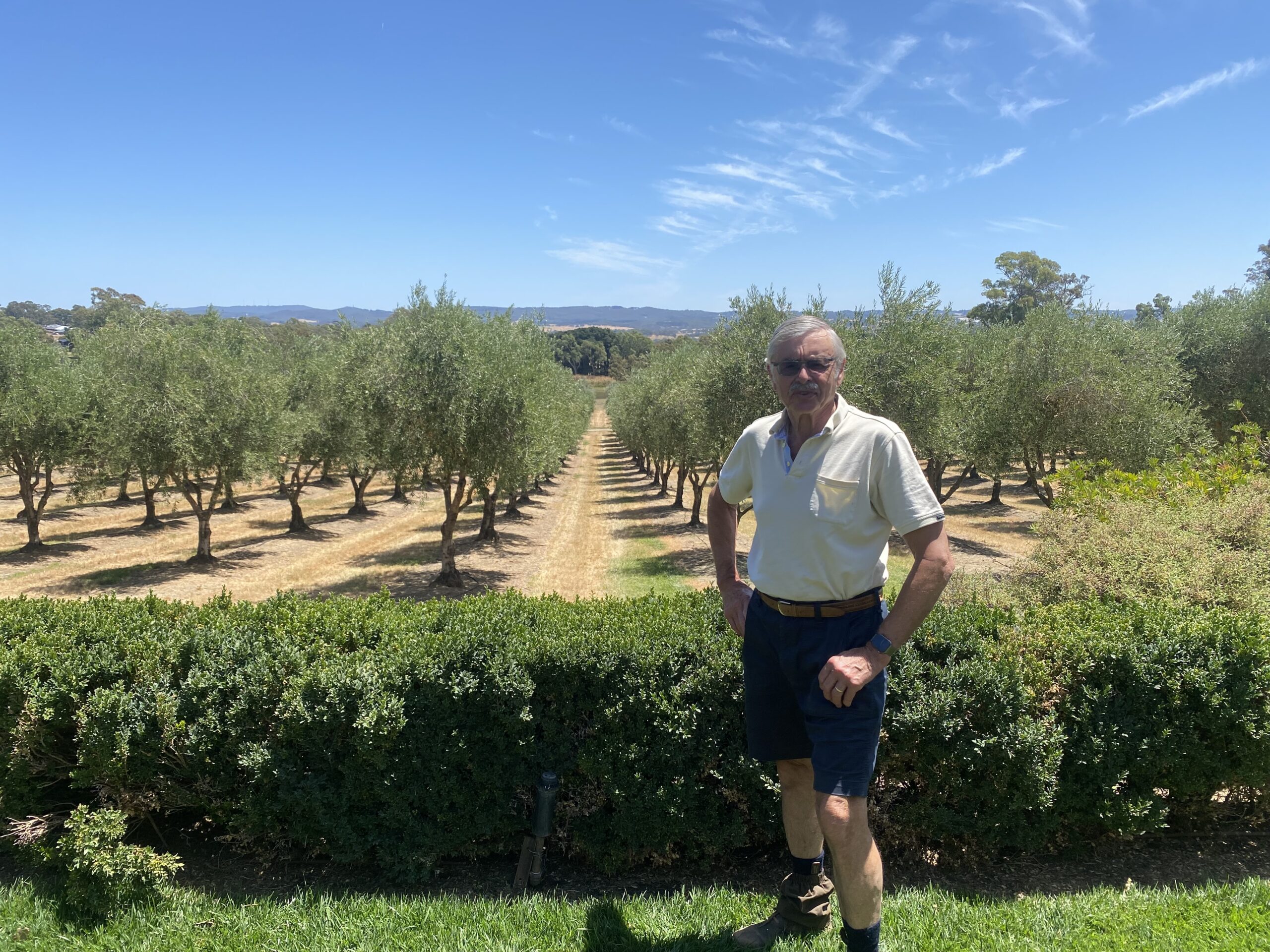
Woodside Farm today: Olive grower Ron Baker is pictured in his Adelaide Hills grove, six years after it was impacted by bushfire (Image: Ron Baker).
By Laura Thomas
South Australian olive grower Ron Baker knows better than most – “it’s hard to kill an olive tree”.
His and wife Ethne’s 6,400-tree grove, Woodside Farm, was severely impacted by the 2019 Cudlee Creek Bushfire.
The fire swept through the Adelaide Hills just days before Christmas, destroying 23,000ha and devastating local communities.
More than 2,800 trees and 14km of irrigation were destroyed at Woodside Farm.
But six years, a lot of hard work and an intense rejuvenation process later, the grove is thriving again.
“We had to decide on management of the burnt trees without an external voice of experience to guide us,” Mr Baker said earlier this week.
“Today the grove looks good, but don’t look too hard at some of the trunks.
“Actual tonnes of production has also been constant since 2021, without any alternate year variation, water and pruning.
“I think our production potential was compromised by the fire as the trajectory has flattened off, but a very good fruit set this year is a reason for optimism.”
Mr Baker admits he is “unfortunately” qualified to talk on the topic of bushfire recovery.
But he hopes his lived experience and lessons learned along the way will provide practical advice to other growers navigating their own way forward after last month’s Victorian fires.
Read on to find out how successful fire recovery was achieved at Woodside Farm.
The first steps forward
Initially the extent of the damage was overwhelming, but it soon became apparent that water was the main priority.
In retrospect, the plan was straightforward, but there were many obstacles and factors for consideration.
“There were just two working days before Christmas, irrigation tubing in irrigation businesses was soon snapped up, factories were closing for the Christmas break. In the New Year, Netafim was able to get one of their production lines working with volunteer employees who gave up their holidays,” Mr Baker said.
A total of 14km of burnt irrigation dripper tubing was collected during an Olives SA working bee. Whole filter stations and wiring were repaired and replaced.
“Irrigation tubing was finally rolled-out in January 2020. We had our irrigation back within a month, as the entire month had almost been continuously hot to very hot.”
And while this task was immense on its own, burnt livestock, insurance and business administration also required urgent ongoing attention.
“In the background I was tending to burnt cattle, many of which I had to destroy,” Mr Baker said.
“We were starting the clean-up of destroyed sheds and fencing, talking to suppliers and insurance assessors and paying costs and wages like the paymaster of a small corporation.
“We were also dealing with other burnt trees. We lost many old growth eucalypts the last of which fell over burning within three weeks after the fire.”
Tree management
Mr Baker said the biggest decision was management of the 2,852 burnt trees – without any experience to guide him.
It was eventually decided the trees would be cut through the primary branches at a height of 1.2 – 1.5m from the ground, all waste material pulled into rows and then mulched.
It was thought this approach would allow easier management of shoots to form a productive tree again.
By March / April 2020 most trees were shooting and this has now become Woodside Farm’s favoured low-cost pruning method to assure a crop in the third year.
In the end, 1,403 trees were regrown from the branches. A total of 316 of these trees had greater than 50% circumferential burn to the trunk.
“Now in 2026, the trunks still look bad but look along the row – the tops are even and they are productive in the third year,” Mr Baker said.
A further 929 trees were cut and regrown from the base after their branches failed to shoot. But this approach proved much less successful in the long run.
“The best basal shoot eventually grew into a productive tree, however when presented with the shaker (during harvest) many fell apart,” Mr Baker said.
“It was a poor result for all of the effort to get them to that point, particularly dealing with constant shooting.
“But with hindsight and advice provided by an arborist, this was predictable as the shoots had derived from epicormic growth. The tree’s internal tethering will often be weak, especially if grown via a shoot from a root.
“Thus trees that do not shoot from the branches should be pulled out.”
An additional 520 trees were also replanted, most of which were recent plantings. This was a successful, lower-cost option, according to Mr Baker.
“It’s hypothetical, but if ever faced with this again, I would be pulling out more trees,” he said.
“To grow a young tree is a much lower cost. It may be later to fruit but you would be better off.”
Importance of fire preparedness
Mr Baker said fire preparedness was a vital for farm protection.
“We are no more fire-prepared now than before the fire,” he said.
“We keep the dry grass low, we have our 2,000L fire cart attached to the tractor, we have sprinklers installed on the house and sheds.”
But he warned the greatest losses were not financial.
“If it’s a catastrophic fire risk day you have to have plans to get to safety,” Mr Baker said.
“Fire is potentially always with us in Australia. Farmers can face crippling losses with far greater lasting effects than financial.
“I would not like this experience again, but we were ok.”
A word of encouragement
“The only encouragement I can give is it’s hard to kill an olive tree,“ Mr Baker said.
“If you have been burnt and are not coping get help ASAP.”
Mental health and financial support
As fire recovery continues, it’s important to know that mental health support is available and to access it when you need to. Click here for resources and links.
Grants, loans, livestock support, fencing and water information is available for farmers and primary producers affected by the January 2026 Victorian bushfires. Click here for more information.
Read more
The effects of the fire and recovery process at Woodside Farm have been well documented in Australian & New Zealand Olivegrower & Processor magazine over the years and it’s all available to view on the AOA website.
Read more on the Woodside Farm story as reported in the March 2020 edition, or find out how recovery looked two years on, as detailed in March 2022.